Steel
Steel AR 400
Applications
AR400 is used in applications requiring high abrasion and wear resistance combined with good impact toughness and ease of fabrication. Common applications include: dump truck body liners, bulldozer and excavator bucket liners, material transfer chutes, conveyor system components, hoppers and storage bins, cement mixer drums and fins, mining and quarrying equipment liners, construction and earthmoving equipment wear parts, and rifle range silhouette targets. It is particularly well-suited for moderate-to-heavy wear environments where both abrasion and impact forces are present.
Corrosion Resistance
AR400 offers fair resistance to atmospheric corrosion due to its chromium content, making it suitable for outdoor applications where weathering is a concern. However, it exhibits limited corrosion resistance in environments containing chlorides and acids, and is susceptible to pitting and stress corrosion cracking in aggressive environments. AR400 is not recommended for hot-dip galvanizing; residual stresses from cutting, bending, welding, or drilling can cause cracking during the galvanizing process. Protective coatings are recommended for corrosive service environments.
Formability
AR400 (AR400F) provides improved formability over other abrasion-resistant grades, achieved through low levels of carbon and sulfur for inclusion shape control. For plates up to 0.75 inch thick, cold bending to a minimum inside bend radius of 3t (where t is plate thickness) is achievable with the bend axis transverse to the rolling direction; a radius of 4t is recommended parallel to the rolling direction. For plate over 0.75 inch, a radius of 6t is recommended transverse to the rolling direction. Shear burrs, heat-affected zones from thermal cutting, and sharp corners near the bend axis should be removed by grinding prior to cold forming. Preheating may be used for cold forming to achieve tighter bends and prevent cracking.
Heat Treatability
AR400 is supplied in the quenched and tempered condition. It is not recommended for re-heat treating in the field, as additional heat treatment would alter the hardness profile. The material should not be used in applications where service temperatures exceed approximately 400°C (752°F), as the tempered martensite microstructure will begin to lose hardness and mechanical properties at elevated temperatures.
Machinability
AR400 presents significant challenges in machinability due to its high hardness (360–444 HBW). Drilling, countersinking, counterboring, tapping, milling, and general machining operations are possible using conventional equipment with carbide-tipped tools. Slow feed rates and appropriate cutting speeds with high-performance tooling and coolant are recommended to manage tool wear and extend tool life.
Other Comments
AR400 is produced by multiple steel mills under proprietary trade names including Tensalloy 400 (Clifton Steel), Wearalloy 400 (Ford Steel), Hardox (SSAB), and others. Chemical composition and hardening processes differ between mills. There is no single ASTM specification covering AR400 as a grade; it is defined solely by its hardness range of 360–444 HBW. Mill test reports (MTRs) are supplied with each order and should be referenced for lot-specific composition and properties. AR400 is sometimes also referred to as AR400F (Formable), which emphasizes the improved formability characteristics of modern low-carbon, low-sulfur versions of this grade.
Other Mechanical Properties
Brinell hardness range: 360 minimum / 400 nominal / 444 maximum HBW, measured on a milled or ground surface per ASTM A370. Typical tensile strength: 180–200 KSI. Typical yield strength: 140 KSI minimum. Typical elongation: approximately 14.8% in 8 inches. Charpy V-notch impact strength (Clifton Steel Tensalloy data): average values of 15 ft-lbs at -40°F. AR steels are not intended for structural design applications.
Other Physical Properties
AR400 steel has a density of approximately 7.85 g/cm³ (0.284 lb/in³), consistent with standard carbon and low-alloy steels. The melting point range is approximately 2500–2800°F. Thermal conductivity is approximately 46 W/m·K (26.6 BTU/hr·ft·°F). The modulus of elasticity is approximately 29 MSI (200 GPa), typical for carbon steel.
Principle Design Features
AR400 is a quenched and tempered, through-hardened abrasion-resistant steel defined by its Brinell hardness range of 360–444 HBW (nominal 400 HBW) rather than a fixed chemical composition. It achieves its hardness through a chrome-moly-boron alloy system combined with a quench and temper heat treatment. There is no single governing ASTM specification for AR400; the grade is produced by multiple mills under various trade names (e.g., Tensalloy 400, Wearalloy 400, Hardox, AR400F). AR400 is not intended for structural use.
Weldability
AR400 has good weldability and can be welded using conventional electric arc welding processes. Due to its hardness, careful welding procedures are required to maintain structural integrity and prevent cracking. Key recommendations include: preheating to reduce thermal stress (preheat temperature depends on plate thickness and carbon equivalent), use of low-hydrogen filler metals (e.g., E7018) with maximum hydrogen potential of 5 ml/100g for the weld deposit, and controlled post-weld cooling to maintain hardness and prevent hydrogen-induced cracking.
Known Forms
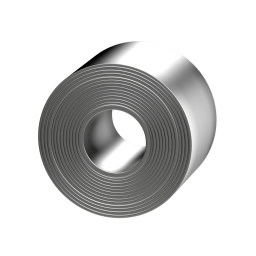
Coil
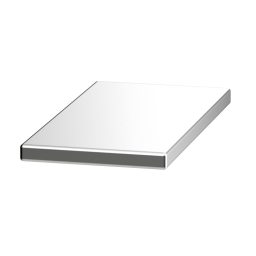
Flat Bar
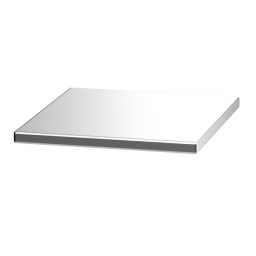
Plate
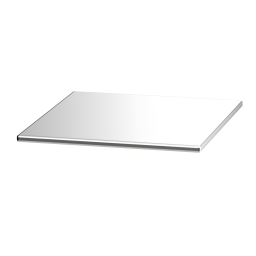
Sheet
Additional Data
Specifications
A6Chemical Elements
| Boron | Range 0.0005–0.005% per KMAC datasheet; boron treatment for through-hardness |
| Carbon | Typical max 0.20%; some mill datasheets show 0.12–0.16 typical. Composition varies by mill; grade is |
| Chromium | Max 0.55% per KMAC datasheet; contributes to hardenability and corrosion resistance |
| Iron | Balance |
| Manganese | Max 1.55% per KMAC datasheet |
| Molybdenum | Max 0.55% per KMAC datasheet; contributes to hardenability and strength at temperature |
| Nickel | Max 1.00% per KMAC datasheet |
| Phosphorus | Max 0.025% |
| Silicon | Range 0.35–0.55% per KMAC datasheet |
| Sulfur | Max 0.005%; kept very low for inclusion shape control and toughness |
Physical Properties
Density: 0.284lb/in³
Melting Point: 2500°F
Modulus of Elasticity: 29MSI