Aluminum
Aluminum 5052
Annealing Procedure
5052 aluminum is annealed by heating to 345°C (653°F); time at temperature and cooling rate are not critical. A full anneal can be achieved using recovery/anneal cycles in the 300–415°C range followed by controlled cooling to restore ductility and reduce residual stresses. Stress relief, when required, can be carried out at approximately 220°C (428°F).
Applications
5052 aluminum is used across a broad range of industries including marine (boat hulls, decks, fuel tanks, gangways), transportation (truck trailers, pressure vessels, road and highway signs, automobile body panels), industrial (sheet metal enclosures, storage tanks, chemical drums, heat exchangers), consumer goods (kitchen equipment, appliances, electronics housings), and architecture (signage panels, decorative facades, roofing). Additional uses include fan blades, electronic chassis, hydraulic pipes, fasteners, hardware, hospital and medical equipment, and cooking utensils.
Cold Workability
5052 is easy to cold work. It can be formed by spinning and drawing, and is very readily cold formable in the annealed condition due to its high ductility. Depending on the extent of deformation (e.g., spinning), intermediate annealing may be required between forming steps to restore ductility. The alloy work-hardens effectively, allowing strength to be tailored through controlled cold reduction.
Corrosion Resistance
5052 has the same high resistance to general corrosion as other non-heat-treatable aluminum alloys, with an additional higher resistance to slightly alkaline conditions common to the 5000 series alloys. Its resistance to corrosion in marine atmospheres is excellent, exceeding that of 5005, making it a primary candidate for marine structures. The alloy is highly resistant to saltwater corrosion due to the absence of copper in its composition. Its high magnesium content enhances resistance to chemical attacks including concentrated nitric acid, ammonia, and ammonium hydroxide. It may experience localized pitting corrosion in alkaline soils. The alloy can be anodized to improve corrosion resistance by thickening the protective surface film. 5052 resists stress-corrosion cracking up to 90% of its yield strength in chloride-rich environments.
Formability
5052 is the aluminum alloy most suited to forming operations. It can be easily formed at room temperature in all tempers; the annealed (O) condition provides the best formability and is recommended for deep drawing and complex forming operations. It can be formed by spinning, drawing, and bending. Consecutive cold working tends to reduce the alloy's formability. For piercing and blanking, the punch-to-die clearance should be about 7% of the thickness per side for H32 and H34 tempers. Forming loads and tool wear are generally less than with carbon steel. 5052 is very readily cold formable in the annealed condition due to its ductility.
Hardening Procedure
5052 can be hardened by cold working only. Since the alloy spontaneously ages at room temperature after cold work, all flat-rolled mill products are supplied in stable H3x tempers via a stabilization thermal treatment (typically 120–170°C for 2–6 hours). H32 requires approximately 25% cold rolling reduction; H34 approximately 50%; H38 approximately 75%.
Heat Treatability
5052 is a non-heat-treatable alloy. It cannot be strengthened by solution treatment and precipitation aging. Attempts to apply conventional heat treatment (T-temper style) are ineffective and can degrade corrosion resistance and dimensional stability. Strength is controlled exclusively through cold working and controlled annealing cycles.
Hot Workability
5052 aluminum is not generally hot worked. Hot working can be performed from approximately 950°F (510°C) down to 500°F (260°C) if required, but cold forming is strongly preferred for this alloy.
Machinability
The machinability of 5052 aluminum is rated as fair. It can be more easily machined in the hard temper than in annealed form, and the quality of finish is better in harder tempers. Machining should be performed at high speed with copious lubrication to avoid thermal distortion. Sharp tools are essential; high-speed steel or tungsten carbide tools may be used. Cuts should be deep and continuous, with high cutting speeds. All machining other than very light cuts should be done using oil lubricants. Overall machinability is below 6xxx alloys; designers should minimize heavy machining where possible.
Other Mechanical Properties
Shear strength (H32): approximately 20 KSI (138 MPa). Shear modulus: approximately 3,760 KSI (25.9 GPa). Fatigue endurance limit: approximately 16 KSI (110 MPa) in H32 temper and 18 KSI (125 MPa) in H34 temper at 500 million cycles. The alloy exhibits high fatigue strength relative to its static strength, making it suitable for applications with cyclic loading.
Principle Design Features
5052 is a non-heat-treatable aluminum-magnesium alloy from the 5xxx series, primarily alloyed with magnesium (2.2–2.8%) and chromium (0.15–0.35%). It offers a combination of medium-to-high static strength, excellent corrosion resistance (especially in marine atmospheres), high fatigue strength, good weldability, and excellent formability. Strength is achieved through cold working rather than heat treatment, with common tempers including O (annealed), H32 (quarter-hard, stabilized), and H34 (half-hard, stabilized). It is one of the higher-strength non-heat-treatable aluminum alloys and is widely considered the most suitable aluminum alloy for forming operations.
Weldability
5052 is readily weldable by standard techniques including GTAW (TIG) and GMAW (MIG). Excellent results are obtained using filler alloys 5356 (preferred for color match and crack resistance) or 4043 (most crack tolerant). Filler metals 1100 and 4047 may also be used. Aluminum must be very dry and clean to avoid contamination and porosity of the weld. Pre- and post-weld heat treatments are generally not required for non-critical components. The alloy retains up to 85% of base-metal strength in welded joints.
Known Forms
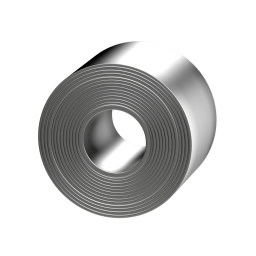
Coil
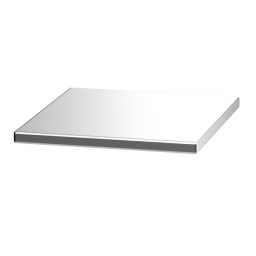
Plate
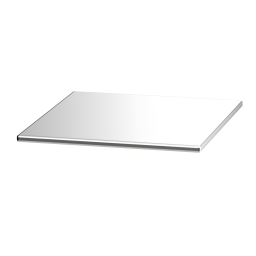
Sheet
Treadplate
Additional Data
Specifications
B209Chemical Elements
| Aluminum | Balance |
| Chromium | 0.15 - 0.35 |
| Copper | 0.1 max |
| Iron | 0.4 max |
| Magnesium | 2.2 - 2.8 |
| Manganese | 0.1 max |
| Silicon | 0.25 max |
| Zinc | 0.1 max |
Physical Properties
Density: 0.0968lb/in³
Electrical Resistivity: 4.99µΩ·cm
Melting Point: 1125°F
Modulus of Elasticity: 10.2MSI
Specific Heat: 0.21BTU/lb·°F