Aluminum
Aluminum 3003
Annealing Procedure
3003 aluminum is annealed by heating to approximately 775°F (413°C) followed by controlled cooling to fully restore ductility and relieve cold-work stresses. This produces the O (fully annealed) temper with maximum formability and minimum strength. Partial annealing or stabilization treatments at lower temperatures produce the H2x series of tempers.
Applications
Aluminum 3003 is widely used in HVAC ductwork, heat exchangers, cooking utensils and cookware, food and chemical handling equipment, storage tanks, pressure vessels, piping, architectural cladding and trim, gutters and downspouts, roofing and siding materials, insulation panels, fuel tanks, and general sheet metal fabrication requiring moderate strength with excellent formability and corrosion resistance.
Cold Workability
3003 aluminum has excellent cold workability using all conventional techniques including rolling, drawing, bending, spinning, and stamping. Cold working is the primary means of increasing strength, producing the H1x series of tempers. Intermediate annealing can be employed between cold-working steps to restore ductility and allow further deformation without cracking.
Corrosion Resistance
3003 aluminum has very good corrosion resistance due to the naturally forming aluminum oxide passive film. The relatively low copper and zinc content minimizes galvanic corrosion susceptibility. It resists oxidizing environments and urban and industrial atmospheres effectively, making it suitable for outdoor architectural applications, ductwork, and enclosures. In marine environments it is acceptable for many structural and decorative applications, though higher-alloyed marine grades such as 5083 or 5086 are preferred for severe marine exposure.
Formability
3003 has excellent formability, particularly in the annealed (O) temper, where deep drawing, spinning, bending, stamping, and roll forming to tight radii are readily achievable. Minimum bend radii in O temper can be as low as 0t to 0.5t for thin gauges. As temper increases from H12 through H18, formability decreases and required bend radii increase. Intermediate annealing can restore formability after heavy cold deformation. It is one of the most formable aluminum alloys available.
Hardening Procedure
3003 aluminum is hardened exclusively by cold working (strain hardening). The degree of cold reduction controls the final temper: H12 (quarter hard, ~25% reduction), H14 (half hard, ~50% reduction), H16 (three-quarter hard, ~75% reduction), and H18 (full hard, ~75%+ reduction). No heat treatment is required or effective for hardening this alloy.
Heat Treatability
3003 is a non-heat-treatable alloy and does not respond to solution treatment and artificial aging for strengthening. Attempts to apply precipitation hardening cycles used for 6xxx or 7xxx series alloys will not increase strength. Properties are controlled entirely by chemical composition and the degree of cold work applied.
Hot Workability
3003 aluminum can be hot worked using conventional techniques in the temperature range of 500–950°F (260–510°C). Hot working within this range allows significant deformation with good material flow. Care should be taken to avoid working at temperatures below the recommended range, which can lead to cracking.
Machinability
3003 aluminum has good machinability characteristics. It can be readily cut, drilled, and machined using conventional techniques. However, its relatively soft and gummy nature in the annealed condition may cause built-up edge on cutting tools; harder tempers (H14, H18) generally provide better machined surface finishes. Sharp tooling and appropriate feeds and speeds are recommended to minimize burring.
Other Comments
3003 is the most widely used of all aluminum alloys due to its combination of moderate strength (approximately 20% greater than 1100 series), excellent formability, very good weldability, and good corrosion resistance at a relatively low cost. It is available in a wide range of tempers (O, H12, H14, H16, H18, H112) and product forms including sheet, coil, plate, treadplate, drawn tube, extruded shapes, and bar. International equivalents include EN AW-3003, DIN 3.0517, ISO AlMn1Cu, and JIS A3003.
Other Physical Properties
3003 aluminum has a melting range of approximately 1190–1210°F (643–654°C). Its electrical conductivity is approximately 40–44% IACS, with an electrical resistivity of approximately 4.16 µΩ·cm. The alloy is non-magnetic. Thermal diffusivity is relatively high due to the combination of good thermal conductivity and low density, making it advantageous for heat exchanger applications. Thermal expansion must be accounted for in designs involving joints with dissimilar materials.
Principle Design Features
3003 is a non-heat-treatable wrought aluminum-manganese alloy (3xxx series) with manganese (1.0–1.5%) as the primary alloying element. It is approximately 20% stronger than commercially pure 1100 aluminum. Strength is achieved exclusively through cold working (strain hardening); tempers range from fully annealed (O) through H12, H14, H16, to fully hard (H18). It offers an excellent balance of moderate strength, superior formability, good weldability, and very good corrosion resistance at low cost, making it the most widely used general-purpose aluminum alloy.
Weldability
3003 aluminum has excellent weldability and is readily joined by gas tungsten arc welding (GTAW/TIG), gas metal arc welding (GMAW/MIG), resistance welding, brazing, and soldering. Because strengthening is mechanical rather than heat-treatment dependent, welding does not produce susceptibility to cracking from precipitation effects; however, localized softening in the heat-affected zone (HAZ) can slightly reduce strength adjacent to welds. Filler alloys such as 1100 or 4043 are commonly used.
Known Forms
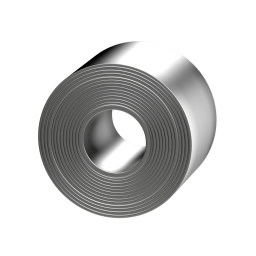
Coil
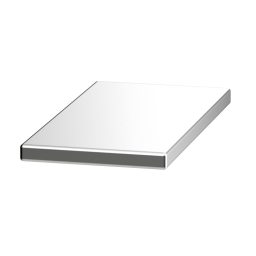
Flat Bar
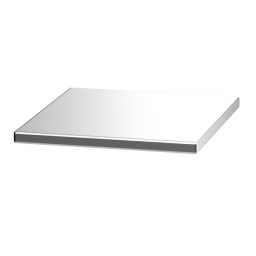
Plate
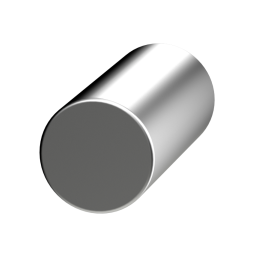
Round Bar
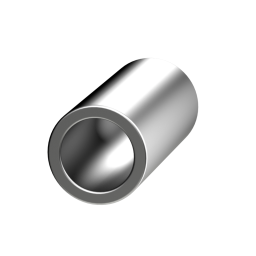
Round Tube
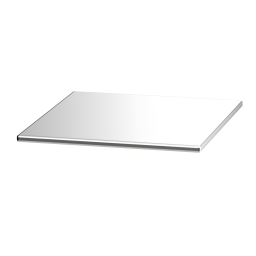
Sheet
Treadplate
Additional Data
Specifications
B209Chemical Elements
| Aluminum | Balance |
| Copper | Modestly increases strength |
| Iron | Maximum limit per ASTM B209 |
| Manganese | Primary alloying element; provides solid-solution strengthening |
| Other Elements Each | Maximum per ASTM B209 |
| Other Elements Total | Maximum per ASTM B209 |
| Silicon | Maximum limit per ASTM B209 |
| Zinc | Maximum limit per ASTM B209 |
Physical Properties
Density: 0.0986lb/in³
Electrical Resistivity: 4.16µΩ·cm
Melting Point: 1190°F
Modulus of Elasticity: 10MSI
Specific Heat: 0.213BTU/lb·°F